 a Muslim-Israeli rampaged through a Jerusalem Bible seminary, machine-gun-massacring more than 18 youngsters. The attacker, 20-year-old Alaa abu Dhein, entered the yeshiva seminary and opened fire of more than 400 rounds on students in a planned attack, murdering 7 adolescent students, one 26-year-old student; and wounding more than 10 more boys. Witnesses say that the attack began in the seminary's library with the terrorist spraying bullets in every direction before anyone could react.
 "It was a slaughterhouse," said Yehuda Meshi-Zahav, head of the Zaka emergency service after surveying the scene at the Merkaz Harav seminary, one of the most prominent Jewish educational centres in Jerusalem.

"Blood covered the religious books. Blood covered the floors. Blood covered the white prayer shawls the boys wore.

In fact, the white prayer shawls were completely soaked with red," reports FOX News reporter, Reena Ninan.
"One Orthodox Jewish man came up to me and said, "I want you to report this attack means something completely different to us because it wasn't on a bus or a coffee shop ... it was in the most sacred place for us Jews ... an institute of Jewish holiness and sanctification!"
Here is a range of video clips covering the massacre from varying perspectives: from eyewitness footage of the crime-scene, to Britain's Channel Four News' diverting the tragedy to Israel or blame to Palestinian; to Iran's global English "Press TV" Channel justifying the action. Also available are the Israeli reaction, a New York reaction, and several memorial tributes on YouTube attempting to find meaning from the tragedy. (Click on the second button for video menu, or the arrow on the right margin to advance to the next of 12 videos).
As a Jewish Ethiopian mother came to identify her dead son’s body at the school, she was crying loudly. Her other son shouted in Hebrew, "I will avenge for my brother's blood that was spilled."
 The part-time yeshiva student who killed the terrorist, 40-year-old Yitzchak Dadon, said that he shot the attacker in the head with his personal weapon. David Shapira, a yeshiva graduate and officer in the paratroopers, heard the shots from his nearby home, ran to the yeshiva and "finished [the terrorist] off."
Asked by a Channel 2 TV reporter what weapon the Palestinian Authority terrorist had, Dadon said, "A Kalachnikov," and turning to the camera, he angrily added, "The Kalachnikov that you gave him, President Peres ..."
The scene outside the yeshiva was furious and passionate, with at least 50 ambulances and as many police cars on the streets outside, and angry yeshiva students and local residents lined up behind police tapes, chanting, “Death to Arabs,” “Olmert — you are to blame” and “Who gave them weapons?”

 The Merkaz HaRav Yeshiva is located near the entrance to Jerusalem, in the Kiryat Moshe neighborhood. The yeshiva, founded by Rabbi Avraham Yitzchak Kook, is at the heart of the national-religious movement in Israel.
 McGill University's Gil Troy's: "Blackening the Palestinian soul," OpEd's in Canada's National Post:
Although the attack itself was carried out on behalf of a terrorist organization it is still not clear which one. Several have claimed credit, including Hamas, which later retracted its statement. A relatively new terrorist gang, calling itself the Martyrs of Imad Mughniyeh (the Hizbullah second-in-command who was assassinated in Damascus last month) also claimed responsibility, as did an Israeli-Arab terrorist group in the Galilee.
All but one of the 8 murdered students are high-school aged boys: 
 Avraham David Moses, 16, of Efrat (pictured); Yochai Lipschitz, 18, of Jerusalem; Yonatan Yitzchak Eldar, 16, of Shiloh; Yonadav Chaim Hirschfeld, 19, of Kochav Hashahar; Neriah Cohen, 15, of Jerusalem; Roey Roth, 18, of Elkana; Segev Pniel Avihayil, 15, of Neveh Daniel; and Maharata Trunoch, 26, of Ashdod.
It was the deadliest attack on Israeli civilians in nearly two years and the first attack inside Jerusalem in four. It occurred at the start of the Hebrew month in which the Purim holiday occurs, and many of the witnesses at first thought the gunfire was firecrackers in celebration.

 Avraham David Moses, 16, of Efrat (pictured); Yochai Lipschitz, 18, of Jerusalem; Yonatan Yitzchak Eldar, 16, of Shiloh; Yonadav Chaim Hirschfeld, 19, of Kochav Hashahar; Neriah Cohen, 15, of Jerusalem; Roey Roth, 18, of Elkana; Segev Pniel Avihayil, 15, of Neveh Daniel; and Maharata Trunoch, 26, of Ashdod.
It was the deadliest attack on Israeli civilians in nearly two years and the first attack inside Jerusalem in four. It occurred at the start of the Hebrew month in which the Purim holiday occurs, and many of the witnesses at first thought the gunfire was firecrackers in celebration.
 The part-time yeshiva student who killed the terrorist, 40-year-old Yitzchak Dadon, said that he shot the attacker in the head with his personal weapon. David Shapira, a yeshiva graduate and officer in the paratroopers, heard the shots from his nearby home, ran to the yeshiva and "finished [the terrorist] off."
Asked by a Channel 2 TV reporter what weapon the Palestinian Authority terrorist had, Dadon said, "A Kalachnikov," and turning to the camera, he angrily added, "The Kalachnikov that you gave him, President Peres ..."
The scene outside the yeshiva was furious and passionate, with at least 50 ambulances and as many police cars on the streets outside, and angry yeshiva students and local residents lined up behind police tapes, chanting, “Death to Arabs,” “Olmert — you are to blame” and “Who gave them weapons?”
Daniel Seaman, head of the Israeli government press office, said: “Jerusalem is a town where Jews and Arabs live together. The terrorist took advantage of the fact that he could move freely in west Jerusalem.”
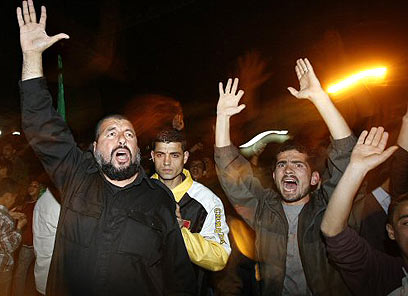
In Gaza City, Palestinians went out into the streets and fired rifles in the air in celebration of the attack against the Jews of Jerusalem. Some fired weapons in the air, and threw sound bombs in the streets, while drivers pressed on their cars horns. Other Palestinians delivered candies and sweets in the streets in celebration. Mosques loudspeakers in Gaza also broadcasted verses of the Quran, the Moslem holy book, with speakers saying "we congratulate our people for the heroic and selective attack in Jerusalem."
The Abu Dhein family gave public celebrations in Jerusalem and in Jordan to honor their son's 'martyrdom.' Consistent with IDF policy, the home of the terrorist was subsequently razed to the ground by bulldozers.

Asked what the government should do, Rabbi Nachum Levy, 60, said: “I would like to see Olmert go with a strong hand.” Where? “Everywhere, in Gaza and the north and inside,” he said, “and not dismantle settlements.” (from Israel National News & combined sources).
 McGill University's Gil Troy's: "Blackening the Palestinian soul," OpEd's in Canada's National Post:
 "The celebration of this sort of slaughter entails a dehumanization of the victims so intense as to dehumanize the apologist. Such hatred is all-consuming.
This addiction to violence has been the Palestinian national movement's central failing. The repeated embrace of violence over compromise, and the celebration of barbaric terrorist attacks, serve to blacken the soul, individually and collectively."
This addiction to violence has been the Palestinian national movement's central failing. The repeated embrace of violence over compromise, and the celebration of barbaric terrorist attacks, serve to blacken the soul, individually and collectively."
The Jerusalem Post reports that the 3-month rookie police officer who was the first to arrive at the scene of the terrorist attack at Jerusalem's Mercaz Harav Yeshiva on March 6 but failed to enter the building and engage the attacker remains on active duty, police said Wednesday.
The 22-year-old sergeant, who completed his training at the police academy three months ago, was performing well, and had not been reprimanded or demoted, Jerusalem police spokesman Shmuel Ben-Ruby said.What motivates crimes of this barbarity among Arab-Muslims? Investors' Business Daily published this editorial with one answer:
Jerusalem police chief Cmdr. Aharon Franco said Wednesday the officer should have tried to make direct contact with the terrorist, rather than wait at the entrance to the school while the shooting continued.
According to a police investigation, almost two minutes elapsed between the officer's arrival on the scene and the entry into the yeshiva of an off-duty paratrooper captain, David Shapira, who arrived from his nearby home with his M-16 rifle and, together with yeshiva student Yitzhak Dadon, killed the attacker, Ala Abu Dhaim, from the capital's Jebl Mukaber neighborhood.
Abu Dhaim first killed eight, including six high school students, and wounded nine.
Hate That Dares Not Speak Its Name
When a (West Bank-based Palestinian Center for Policy and Survey Research, a professional and independent polling agency that surveys Palestinians four times a year has found that no less than 84% of 1,270 Palestinians questioned by the center in personal interviews said they supported the March 6 shooting inside Jerusalem's Mercaz Harav yeshiva) poll reveals all but a fraction of Palestinians support the murder of eight innocent Jewish seminarians, it shows a people wedded to evil. It's a short trip from this hate to the kind Hitler espoused..
The message we get from this is very clear: The vast majority of Palestinians advocate such acts of terrorism against young innocents because the victims were Jews.
Their version of the Final Solution may not entail gas chambers and concentration camps, as Germany's National Socialists did in the last century. But it does apparently include murdering, at random, Jews because they are Jews. Not to say that there was not a clear political purpose behind the choice of target. The Mercaz Harav yeshiva is considered the flagship of the religious Zionist movement, the roots of which date back to a century and a half ago.
Religious Zionism holds that Jews have an inalienable and permanent right to the land of Israel because God bestowed the Holy Land upon the ancient Israelites. The resettling of Israel by Jews and the establishment of a Jewish homeland there, according to its rabbinical supporters, can hasten the coming of the messiah.
Founded in 1924, the yeshiva's alumni include leading Israeli armed forces officers and prominent rabbis. One of them, Rabbi David Stav, said the attack struck the heart of religious Zionism.
"The terrorist targeted a place that symbolizes love for the land of Israel, love for the people of Israel and love for the Torah," he told the Jerusalem Post.
"No Jewish soul can remain indifferent to the horrible thought that a despicable terrorist attacked a group of young men who were busy studying the holy Torah," added Stav, who has taken part in inter-religious activities with Muslim clerics. "Followers of Islam claim they respect the people of the book. But this horrific act proves the emptiness of their claims."
It's one thing for a tribe or nationality to oppose its neighbors, even by war. Arabs can fight the Israeli military, oppose its settlement policies, and even question the very existence of the state of Israel as artificial. But what we're seeing here sinks far beneath that.
What's at issue here is the difference between ordered liberty and barbarism, between humanity and savagery.
Khalil Shikaki's poll shows that nearly an entire people support the murder of innocent kids because they're religious Jews. The civilized nations once fought a world war to prevent the global dominance of that kind of hate.


