Showing posts with label Qatar. Show all posts

20250606

The Normandy Lesson and the Middle East Delusion: How WWII’s lessons are ignored in today's appeasement of Iran and Hamas

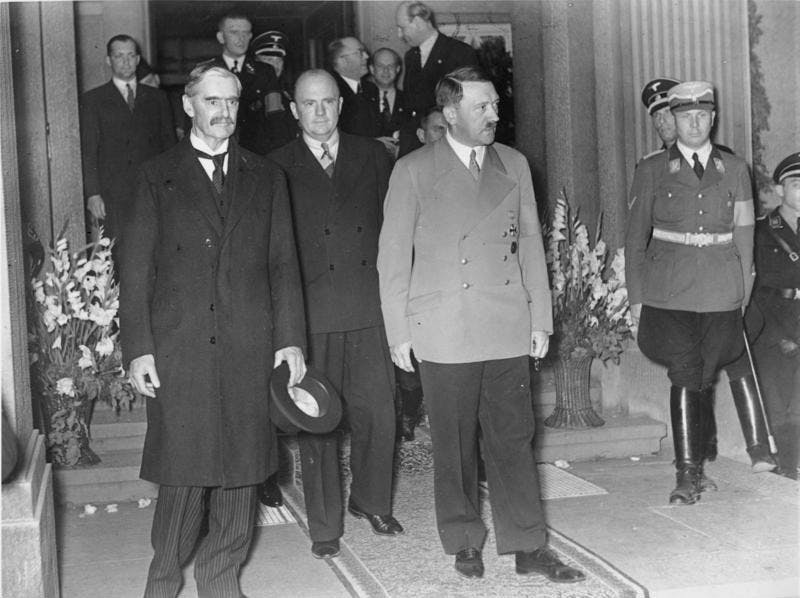
1938: UK PM Neville Chamberlain meets Adolf Hitler to
negotiate the Munich Agreement (photo: FindMyPast)

The Munich Agreement was a pact signed on September 30, 1938, by Germany, the United Kingdom, France, and Italy, aimed at resolving the crisis over Germany's demand for the Sudetenland, a region of Czechoslovakia with a significant ethnic German population. British Prime Minister Neville Chamberlain also led the Conservative Party during this critical period. 

Ultimately failing to avert war, the D-Day invasion of France, which, marking the start of the Allied invasion of Nazi-occupied Western Europe, landed on June 6, 1944 - 5 years and 8 months later. 

On the 81st anniversary of D-Day, we honor the valor of those who stormed the beaches of Normandy, confronting the consequences of delayed action against tyranny. Their sacrifice underscores a timeless lesson: appeasement can embolden aggressors, making eventual confrontation more costly. Today, this lesson resonates as Israel faces threats from Hamas and Iran, and the United States navigates complex diplomatic engagements under President Donald Trump's administration. 

Here’s a breakdown:

Background Context: In the 1930s, Adolf Hitler, leader of Nazi Germany, pursued an aggressive expansionist policy, claiming to unite ethnic Germans into a greater German state.

Sudetenland: This border region of Czechoslovakia had a large German-speaking population. Hitler demanded its annexation, citing alleged mistreatment of Germans by the Czech government, and threatened war.

Appeasement: Britain and France, wary of another devastating war after World War I, followed a policy of appeasement, hoping to satisfy Hitler’s demands and maintain peace.

Key Players

Adolf Hitler (Germany): Sought to annex the Sudetenland as part of his broader goal to expand German territory.

Neville Chamberlain (UK): British Prime Minister, eager to avoid war, championed negotiation.

Édouard Daladier (France): French Premier, aligned with Britain but skeptical of appeasement’s success.

Benito Mussolini (Italy): Acted as a mediator, proposing a compromise to de-escalate tensions.

Notably Absent: Czechoslovakia and the Soviet Union were excluded from the talks, despite Czechoslovakia being directly affected.

The Agreement

Date: Signed in the early hours of September 30, 1938, in Munich, Germany.

Terms:

Germany was allowed to annex the Sudetenland immediately.

The transfer began on October 1, 1938, and was to be completed by October 10, 1938.

An international commission would oversee further border adjustments and plebiscites if needed.

Britain and France agreed to this in exchange for Hitler’s promise to make no further territorial demands in Europe.

Outcome: Chamberlain returned to Britain, famously declaring “peace for our time,” believing the agreement had averted war.    
(video: History Bytes)


Consequences

Short-Term:

Germany occupied the Sudetenland, weakening Czechoslovakia’s defenses and economy. Tensions briefly eased, with Chamberlain hailed as a peacemaker by some.

Long-Term:

Betrayal of Czechoslovakia
: The Czechs, not consulted, lost key territory, industrial resources, and fortifications, leaving them vulnerable.

Emboldened Hitler: Seeing appeasement as weakness, Hitler occupied the rest of Czechoslovakia in March 1939, violating the agreement.

Path to War: The failure of appeasement led to skepticism of diplomacy with Hitler. When Germany invaded Poland on September 1, 1939, Britain and France declared war, marking the start of World War II.

Legacy: The Munich Agreement is now widely seen as a failed act of appeasement, a cautionary tale about conceding to aggressive demands.
  
The agreement delayed war but at the cost of Czechoslovakia’s sovereignty and regional stability.

It exposed the limits of appeasement, shaping future debates on how to confront authoritarian regimes.


Today in 2025, veterans and officials have attended memorial services in Normandy to commemorate the 81st anniversary of the D-Day landings. this report from Britain's ITV News.

A remembrance service was held at the British Normandy Memorial in Ver-sur-Mer, which was attended by the ever-dwindling number of surviving veterans in their late 90s and older, remembering the thousands who died that day. 


Nazi Germany declared its surrender to the Allied nations 11-months after the D-Day invasion. Thirteen weeks later (on August 15, 1945), Japan would surrender to the Allies - commemorated as V-J ("Victory over Japan") Day.  

Veteran pilots of the mighty 8th Air Force of World War II Allied resistance against Axis conquest 

D-Day B-24 airmen reunite in L.A. (l-r) Elmo Maiden, 
Bill Baird, and Wilbur Richardson Fri 6 June 2014
gathered on the 70th anniversary of D-Day, accompanied by their families and friends commemorate the 70th Anniversary of D-Day on Friday, June 6, 2014at the 94th Aero Squadron in Van Nuys, California.  

Several veteran pilots, both of the European and Pacific theaters of operation, shared their experience and attitudes with us about defending liberty from imperialism. The veteran pilots retell their experiences and share perspective on confronting tyranny today.

Wilbur Richardson, a B-17 Ball-Turret Gunner, flew 30 missions in 79 days, and two of them on D-Day. During his 30th mission, the German Axis forces wounded the Air-Force gunner. A highly decorated WWII Combat veteran, he was awarded the Purple Heart and DFC / Distinguished Flying Cross just to list a couple. 


We asked whether he thought the U.S., Canadian, and British countries' sacrifices to save The West from authoritarian tyranny (then Japanese and Nazi German) was worth its cost. He also shares his perception about applying our defenses nowadays to the threats from imperialist Communism and Islamism.

20250508

Trump’s Islamist Concessions: Israel’s Quandry in a Misaligned World

President Donald Trump’s 2024 campaign promises to dismantle Iran’s nuclear program and support Israel’s destruction of Hamas are faltering, selling out Israel and alienating his pro-Israel voter base. 

By conceding on military pressure against Iran’s nuclear ambitions, Trump places the onus on Israel to defy his stated policy through unilateral strikes or sabotage, risking global condemnation in a world where U.S. policy misaligns with actors like Qatar and Iran. 

President Donald Trump's incoming Middle East envoy Steve Witkoff at a Trump campaign rally at Madison Square Garden, New York, October 27, 2024. (AP Photo/Evan Vucci); Prime Minister Benjamin Netanyahu in a government meeting in Nahariya on December 3, 2024. (Maayan Toaf/GPO); Qatari Prime Minister Sheikh Mohammed bin Abdulrahman Al Thani attends a meeting in Egypt's new administrative capital on November 27, 2024. (Khaled Desouki/AFP/ Times of Israel)
A $5.5 billion Trump-branded golf resort deal in Qatar, tied to envoy Steve Witkoff’s $623 million Qatari connections, fuels ethical concerns amid a collapsed Gaza ceasefire. 

A U.S. ceasefire with Iran-backed Houthis, wielding suspected hypersonic missiles, fails to halt their attacks on Israel, emboldening proxies like Hamas, which intensifies Israel’s ground war in Gaza as a by-product. 

As Chinese President Xi Jinping aligns with Vladimir Putin, bolstering Iran through CCP-backed conflicts, Trump’s potential restraint of Israel against Iran and Hamas undermines Israel’s security in increasing U.S. policy alignment with Qatar and Iran.

Gaza Ceasefire Collapses, Ground War as By-Product
Trump pledged to eliminate Hamas, responsible for the October 7, 2023, attack that killed 1,200 and took 251 hostages. A January 15, 2025, ceasefire, brokered by Qatar and Egypt with Witkoff, forced the Israel Defense Forces (IDF) to withdraw from Gaza strongholds, exchanging 33 hostages (eight believed dead) for 1,900 Palestinian prisoners, many terrorism-linked (Israel National News). It collapsed on March 18, 2025, with Operation Might and Sword targeting Hamas’s regrouping (Times of Israel).

On May 4, Israel launched Operation Gideon’s Chariots to seize Gaza, displace 2.3 million residents to a southern “secure zone,” and free 59 hostages. The IDF mobilized approximately 60,000 reservists to bolster three divisions and secure fronts like Lebanon (The Jerusalem Post, May 5). Far-right leaders like Bezalel Smotrich demand permanent occupation (Israel Hayom). A nine-week aid blockade and ground operations, a by-product of Iran’s emboldened proxies like Hamas, have led to 87 IDF casualties since March (Israel National News). Hostage families fear for captives’ safety (Times of Israel).

Eric Trump, executive vice president of the Trump Organization and the US president's son, looks over the proposed plan ahead of the signing ceremony with Qatar's Diar and Dar Global in Doha on April 30, 2025. (Karim Jaafar/AFP/Times of Israel)
Qatar’s Influence and Ethical Concerns

The $5.5 billion Simaisma golf resort deal, announced April 30, 2025, with Qatar’s Qatari Diar and Saudi-backed Dar Global, features an 18-hole golf course, 3,600 villas, 3,000 apartments, a 400-room hotel, and a waterfront promenade (Trump Organization press release).

Eric Trump praised it, but Witkoff’s $623 million Qatari ties from a 2016 hotel sale raise conflict-of-interest concerns, given Qatar’s Hamas mediation role (Israel Hayom). X posts criticize: “Trump profits from Qatar while Israel fights” (
@TimesofIsrael
, May 2). This deal highlights U.S. policy misalignment, favoring Gulf interests over Israel’s security (America First Policy Institute, April 28).

Iran Concession: Forcing Israel’s Nuclear Defiance

Trump’s pledge to “defang” Iran’s nuclear program, a cornerstone of his pro-Israel stance, has been abandoned. After exiting the 2015 nuclear deal, he now tolerates 3.67% uranium enrichment, per Witkoff’s Oman talks (Washington Times, April). This concession, forsaking military threats, forces Israel to defy Trump’s stated policy by planning unilateral strikes or sabotage against Iran’s nuclear facilities, risking global demonization (Israel National News, May 7). Israel’s potential operations—precision airstrikes or covert sabotage—face Iran’s fortified defenses, including underground sites like Natanz, per Israel Hayom. The America First Policy Institute (April 28) warns such action could isolate Israel, with U.S. policy misaligned toward actors like Iran and Qatar, undermining Israel’s security (Newsweek, January 12). This sell-out emboldens Iran’s proxies, fueling Hamas’s Gaza resilience as a by-product.

The concession’s drivers include:

  • Practical Strategy: Trump prioritizes Gulf deals like Simaisma to avoid Middle East conflicts, per X posts noting his Qatar focus.
  • Deep-State Influence: State Department diplomats push Iran engagement to counter China, aligning with Witkoff’s diplomacy (Israel Hayom; Modern Diplomacy, February 15).
  • Isolationist Voices: Tucker Carlson’s “America First” rhetoric, critiquing Israel aid on Fox, influences Trump’s base, urging U.S. disengagement (Washington Times).
Houthi Ceasefire and Hypersonic Missiles

On May 6, 2025, Trump halted U.S. bombings of Iran-backed Houthis, claiming they “capitulated,” but failed to require them to stop attacking Israel (Washington Times). The Houthis, targeting Red Sea shipping and Israel, likely use hypersonic missiles supplied by Iran, with speculation of Chinese technology transfers given Beijing’s ties to Tehran (Israel National News, May 7). This ceasefire exposes Israel, with X posts decrying: “Trump’s Houthi deal empowers Iran’s proxies” (@Juliana_Ahavah, May 7). It strengthens Hamas in Gaza, a by-product of Iran’s unchecked influence (Newsweek, January 12).

Global Tensions: China, Russia, and CCP Allies

As Chinese President Xi Jinping aligns with Vladimir Putin, bolstering Iran through CCP-backed conflicts, Trump’s potential restraint of Israel against Iran and Hamas aligns U.S. policy with actors like Qatar and Iran, undermining Israel’s security. Xi’s May 6, 2025, meeting with Putin coincides with Pakistan’s clashes with India and North Korea’s missile launches into the Sea of Japan on May 5, 2025 (Wall Street Journal). China’s potential role in Houthi missile supplies underscores its support for Iran (Israel National News). Trump’s Gulf focus ignores these threats, leaving Israel to counter Iran’s nuclear ambitions and proxies alone.
Prime Minister Benjamin Netanyahu, left, speaks alongside US President Donald Trump during a meeting in the
Oval Office of the White House in Washington, DC, on April 7, 2025. (Kevin Dietsch / Getty Images via Times of Israel)

Restraining Israel: A Double Challenge