Showing posts with label de-nuclearizing iran. Show all posts

20260227

U.S., Israel, Iran, & Qatar: Leverage, Timing, and the Next Phase of Power

Analysts, Kenneth Abramowitz and Rev. Dumisani Washington on force-posture, mediation leverage, and the Iran horizon

The Washington–Qatar–Israel–Iran crisis is no longer a single storyline. It is a convergence of pressure points: Gaza’s unfinished war, Iran’s nuclear trajectory, Chinese-Iranian military ties, and the role of mediators whose influence shapes what Washington considers “realistic.”

Recent Pentagon movements complicate the simple narrative that the United States is hesitating. Reports indicate U.S. refueling aircraft have shifted from Qatar’s Al Udeid Air Base, while the USS Gerald R. Ford carrier strike group has been positioned near Israel’s northern coast. Those moves can signal deterrence, strike preparation, force protection, or leverage in ongoing negotiations. They do not resemble abandonment.

That context matters when revisiting two DemoCast interviews that now feel prescient.

At the Republican Jewish Coalition Leadership Summit on November 2, 2025, geopolitical analyst Ken Abramowitz argued that ideological regimes rarely stop voluntarily. Negotiations may be attempted first, he said, but enforcement ultimately determines outcomes. 

VIDEO: Ken Abramowitz Interview (Nov. 2, 2025)
Two Power Blocs, One Strategic Reality

Mr. Abramowitz frames the Middle East as shaped by two dominant ideological blocs: an axis centered around Qatar and Turkey aligned with the Muslim Brotherhood, and Iran’s revolutionary regime. Whether one agrees with every descriptor, the structural observation stands. Both systems expand influence through proxy networks, financing channels, media ecosystems, and diplomatic positioning.

His strategic claim was blunt: in military affairs you need capability and willingness. Israel, he argues, clearly retains both.  The present question is whether the United States is pacing its use of capability — or withholding willingness.

Hostages, Mediation, and Leverage

Speaking with DemoCast at the NRB Convention in Nashville on Friday, February 20, 2026, Rev. Washington warned that frameworks relying on voluntary disarmament by Hamas were structurally unsound and that political loyalty should never override accountability. 


The hostage-first approach in Gaza inevitably created leverage for Hamas. If hostages are prioritized, the party holding them retains bargaining power. When bargaining power exists, mediators become indispensable.

This is where Qatar’s role becomes structurally significant. Mediation itself is not malign. But when a mediator becomes indispensable, mediation can turn into leverage. The party that controls access controls tempo.

Rev. Washington warned that expecting Hamas to voluntarily disarm misunderstands both its charter and its incentives.

VIDEO: Rev. Washington Interview (NRB Nashville, Feb. 20, 2026)

Rev. Washington believes that if enforcement mechanisms remain theoretical, peace frameworks risk becoming messaging frameworks.


China, Iran, and the Expanding Perimeter

The crisis is not limited to Gaza. Reports that Iran is nearing acquisition of Chinese-made anti-ship missile systems, alongside U.S. sanctions targeting supply chains feeding Iranian drone networks, reflect a widening strategic perimeter. This does not equate to a formal proxy war between Beijing and Washington. But it does indicate that Iran’s military ecosystem intersects with global procurement and partnership channels.

At the same time, homeland security assessments describe a dynamic domestic threat environment shaped by terrorism risks, espionage concerns, and potential retaliatory activation of aligned networks. Major military decisions are never taken in isolation from domestic vulnerability calculations.

Strategic Ambiguity or Strategic Leverage?

The emerging picture may not be surrender or retreat, but coercive diplomacy under guard — military assets positioned visibly enough to deter, negotiations extended long enough to test intentions, and strike capacity held in reserve.

If force posture adjustments are designed to pressure Iran into ceding enrichment capacity or accepting verifiable limits, then delay may function as leverage rather than hesitation.

The evidence suggests stated objectives remain intact: dismantling Hamas’s governing capacity and preventing a nuclear-armed Iran. What appears unsettled is method and sequence.

Major military decisions reflect multi-theater risk assessment: Iranian retaliation, proxy activation, maritime disruption, cyber escalation, and domestic security exposure all factor into the calculus. Strategic pacing may reflect layered risk calculation rather than reversal.

But pacing carries risk. Time can extract concessions — or strengthen the adversary’s depth. Deterrence does not fail when force is delayed. It fails when force is no longer believed possible.

The coming weeks will determine whether current ambiguity produces enforceable constraints — or forces confrontation under less favorable conditions.

Mr. Abramowitz’s warning about capability and will still stands.  Rev. Washington’s warning about confusing messaging for enforcement still stands. 

The difference now is that the chessboard has become visible. The question is not whether the United States is deciding. It is whether its adversaries believe it will.

20250606

The Normandy Lesson and the Middle East Delusion: How WWII’s lessons are ignored in today's appeasement of Iran and Hamas

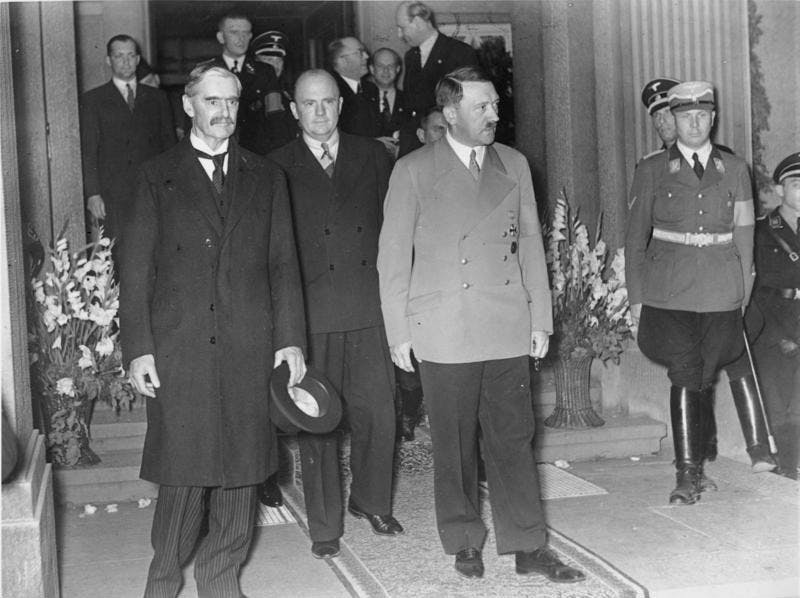
1938: UK PM Neville Chamberlain meets Adolf Hitler to
negotiate the Munich Agreement (photo: FindMyPast)

The Munich Agreement was a pact signed on September 30, 1938, by Germany, the United Kingdom, France, and Italy, aimed at resolving the crisis over Germany's demand for the Sudetenland, a region of Czechoslovakia with a significant ethnic German population. British Prime Minister Neville Chamberlain also led the Conservative Party during this critical period. 

Ultimately failing to avert war, the D-Day invasion of France, which, marking the start of the Allied invasion of Nazi-occupied Western Europe, landed on June 6, 1944 - 5 years and 8 months later. 

On the 81st anniversary of D-Day, we honor the valor of those who stormed the beaches of Normandy, confronting the consequences of delayed action against tyranny. Their sacrifice underscores a timeless lesson: appeasement can embolden aggressors, making eventual confrontation more costly. Today, this lesson resonates as Israel faces threats from Hamas and Iran, and the United States navigates complex diplomatic engagements under President Donald Trump's administration. 

Here’s a breakdown:

Background Context: In the 1930s, Adolf Hitler, leader of Nazi Germany, pursued an aggressive expansionist policy, claiming to unite ethnic Germans into a greater German state.

Sudetenland: This border region of Czechoslovakia had a large German-speaking population. Hitler demanded its annexation, citing alleged mistreatment of Germans by the Czech government, and threatened war.

Appeasement: Britain and France, wary of another devastating war after World War I, followed a policy of appeasement, hoping to satisfy Hitler’s demands and maintain peace.

Key Players

Adolf Hitler (Germany): Sought to annex the Sudetenland as part of his broader goal to expand German territory.

Neville Chamberlain (UK): British Prime Minister, eager to avoid war, championed negotiation.

Édouard Daladier (France): French Premier, aligned with Britain but skeptical of appeasement’s success.

Benito Mussolini (Italy): Acted as a mediator, proposing a compromise to de-escalate tensions.

Notably Absent: Czechoslovakia and the Soviet Union were excluded from the talks, despite Czechoslovakia being directly affected.

The Agreement

Date: Signed in the early hours of September 30, 1938, in Munich, Germany.

Terms:

Germany was allowed to annex the Sudetenland immediately.

The transfer began on October 1, 1938, and was to be completed by October 10, 1938.

An international commission would oversee further border adjustments and plebiscites if needed.

Britain and France agreed to this in exchange for Hitler’s promise to make no further territorial demands in Europe.

Outcome: Chamberlain returned to Britain, famously declaring “peace for our time,” believing the agreement had averted war.    
(video: History Bytes)


Consequences

Short-Term:

Germany occupied the Sudetenland, weakening Czechoslovakia’s defenses and economy. Tensions briefly eased, with Chamberlain hailed as a peacemaker by some.

Long-Term:

Betrayal of Czechoslovakia
: The Czechs, not consulted, lost key territory, industrial resources, and fortifications, leaving them vulnerable.

Emboldened Hitler: Seeing appeasement as weakness, Hitler occupied the rest of Czechoslovakia in March 1939, violating the agreement.

Path to War: The failure of appeasement led to skepticism of diplomacy with Hitler. When Germany invaded Poland on September 1, 1939, Britain and France declared war, marking the start of World War II.

Legacy: The Munich Agreement is now widely seen as a failed act of appeasement, a cautionary tale about conceding to aggressive demands.
  
The agreement delayed war but at the cost of Czechoslovakia’s sovereignty and regional stability.

It exposed the limits of appeasement, shaping future debates on how to confront authoritarian regimes.


Today in 2025, veterans and officials have attended memorial services in Normandy to commemorate the 81st anniversary of the D-Day landings. this report from Britain's ITV News.

A remembrance service was held at the British Normandy Memorial in Ver-sur-Mer, which was attended by the ever-dwindling number of surviving veterans in their late 90s and older, remembering the thousands who died that day. 


Nazi Germany declared its surrender to the Allied nations 11-months after the D-Day invasion. Thirteen weeks later (on August 15, 1945), Japan would surrender to the Allies - commemorated as V-J ("Victory over Japan") Day.  

Veteran pilots of the mighty 8th Air Force of World War II Allied resistance against Axis conquest 

D-Day B-24 airmen reunite in L.A. (l-r) Elmo Maiden, 
Bill Baird, and Wilbur Richardson Fri 6 June 2014
gathered on the 70th anniversary of D-Day, accompanied by their families and friends commemorate the 70th Anniversary of D-Day on Friday, June 6, 2014at the 94th Aero Squadron in Van Nuys, California.  

Several veteran pilots, both of the European and Pacific theaters of operation, shared their experience and attitudes with us about defending liberty from imperialism. The veteran pilots retell their experiences and share perspective on confronting tyranny today.

Wilbur Richardson, a B-17 Ball-Turret Gunner, flew 30 missions in 79 days, and two of them on D-Day. During his 30th mission, the German Axis forces wounded the Air-Force gunner. A highly decorated WWII Combat veteran, he was awarded the Purple Heart and DFC / Distinguished Flying Cross just to list a couple. 


We asked whether he thought the U.S., Canadian, and British countries' sacrifices to save The West from authoritarian tyranny (then Japanese and Nazi German) was worth its cost. He also shares his perception about applying our defenses nowadays to the threats from imperialist Communism and Islamism.

20130917

How Obama's bungled Middle-East agenda bodes for the future

"The Solution: How to Deal with Obama Middle-East Policy" by Barry Rubin 

It is likely that the efforts of the Obama Administration during its second term will fail, not only because of its lack of understanding of the region and its ideology, but also due to the specific agenda.

No Middle Eastern country (only hostile ones or movements) can depend on the United States.  And to clarify this further:  No country -- including Israel -- can depend on the Obama Administration.

But as I noted above, this U.S. policy of Obama’s second term will fail. For example, the main goals of the second term are four big issues:

--Israel-Palestinian peace

--Egypt government coalition with Muslim Brotherhood

--Syrian civil war resolution with rebel victory

--U.S.-Iran rapprochement resolving nuclear issue.

Yet because of irreconcilable differences, these may well be unresolvable. Due to such failures and hardline radical positions (Palestinians, Muslim Brotherhood, Syrian Islamists and regime, Iranian regime), the next administration would probably be forced back on recognition of extremism, support of allies, and U.S. interests.


Thus, regarding the “peace process,” we may well see the typical pattern in which the Palestinians wreck the peace process by rejecting or demanding even more concessions. Once again, it will only be necessary to wait until American negotiators learn better why their goals are impossible. Radicals will just raise their demands and demonstrate their anti-Americanism, and necessary priorities will shift.