Showing posts with label world war iii. Show all posts

20250606

The Normandy Lesson and the Middle East Delusion: How WWII’s lessons are ignored in today's appeasement of Iran and Hamas

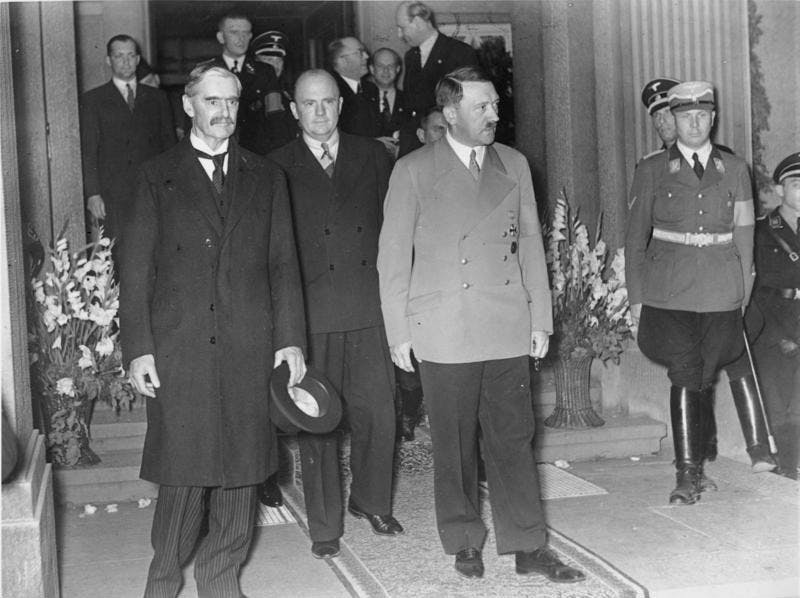
1938: UK PM Neville Chamberlain meets Adolf Hitler to
negotiate the Munich Agreement (photo: FindMyPast)

The Munich Agreement was a pact signed on September 30, 1938, by Germany, the United Kingdom, France, and Italy, aimed at resolving the crisis over Germany's demand for the Sudetenland, a region of Czechoslovakia with a significant ethnic German population. British Prime Minister Neville Chamberlain also led the Conservative Party during this critical period. 

Ultimately failing to avert war, the D-Day invasion of France, which, marking the start of the Allied invasion of Nazi-occupied Western Europe, landed on June 6, 1944 - 5 years and 8 months later. 

On the 81st anniversary of D-Day, we honor the valor of those who stormed the beaches of Normandy, confronting the consequences of delayed action against tyranny. Their sacrifice underscores a timeless lesson: appeasement can embolden aggressors, making eventual confrontation more costly. Today, this lesson resonates as Israel faces threats from Hamas and Iran, and the United States navigates complex diplomatic engagements under President Donald Trump's administration. 

Here’s a breakdown:

Background Context: In the 1930s, Adolf Hitler, leader of Nazi Germany, pursued an aggressive expansionist policy, claiming to unite ethnic Germans into a greater German state.

Sudetenland: This border region of Czechoslovakia had a large German-speaking population. Hitler demanded its annexation, citing alleged mistreatment of Germans by the Czech government, and threatened war.

Appeasement: Britain and France, wary of another devastating war after World War I, followed a policy of appeasement, hoping to satisfy Hitler’s demands and maintain peace.

Key Players

Adolf Hitler (Germany): Sought to annex the Sudetenland as part of his broader goal to expand German territory.

Neville Chamberlain (UK): British Prime Minister, eager to avoid war, championed negotiation.

Édouard Daladier (France): French Premier, aligned with Britain but skeptical of appeasement’s success.

Benito Mussolini (Italy): Acted as a mediator, proposing a compromise to de-escalate tensions.

Notably Absent: Czechoslovakia and the Soviet Union were excluded from the talks, despite Czechoslovakia being directly affected.

The Agreement

Date: Signed in the early hours of September 30, 1938, in Munich, Germany.

Terms:

Germany was allowed to annex the Sudetenland immediately.

The transfer began on October 1, 1938, and was to be completed by October 10, 1938.

An international commission would oversee further border adjustments and plebiscites if needed.

Britain and France agreed to this in exchange for Hitler’s promise to make no further territorial demands in Europe.

Outcome: Chamberlain returned to Britain, famously declaring “peace for our time,” believing the agreement had averted war.    
(video: History Bytes)


Consequences

Short-Term:

Germany occupied the Sudetenland, weakening Czechoslovakia’s defenses and economy. Tensions briefly eased, with Chamberlain hailed as a peacemaker by some.

Long-Term:

Betrayal of Czechoslovakia
: The Czechs, not consulted, lost key territory, industrial resources, and fortifications, leaving them vulnerable.

Emboldened Hitler: Seeing appeasement as weakness, Hitler occupied the rest of Czechoslovakia in March 1939, violating the agreement.

Path to War: The failure of appeasement led to skepticism of diplomacy with Hitler. When Germany invaded Poland on September 1, 1939, Britain and France declared war, marking the start of World War II.

Legacy: The Munich Agreement is now widely seen as a failed act of appeasement, a cautionary tale about conceding to aggressive demands.
  
The agreement delayed war but at the cost of Czechoslovakia’s sovereignty and regional stability.

It exposed the limits of appeasement, shaping future debates on how to confront authoritarian regimes.


Today in 2025, veterans and officials have attended memorial services in Normandy to commemorate the 81st anniversary of the D-Day landings. this report from Britain's ITV News.

A remembrance service was held at the British Normandy Memorial in Ver-sur-Mer, which was attended by the ever-dwindling number of surviving veterans in their late 90s and older, remembering the thousands who died that day. 


Nazi Germany declared its surrender to the Allied nations 11-months after the D-Day invasion. Thirteen weeks later (on August 15, 1945), Japan would surrender to the Allies - commemorated as V-J ("Victory over Japan") Day.  

Veteran pilots of the mighty 8th Air Force of World War II Allied resistance against Axis conquest 

D-Day B-24 airmen reunite in L.A. (l-r) Elmo Maiden, 
Bill Baird, and Wilbur Richardson Fri 6 June 2014
gathered on the 70th anniversary of D-Day, accompanied by their families and friends commemorate the 70th Anniversary of D-Day on Friday, June 6, 2014at the 94th Aero Squadron in Van Nuys, California.  

Several veteran pilots, both of the European and Pacific theaters of operation, shared their experience and attitudes with us about defending liberty from imperialism. The veteran pilots retell their experiences and share perspective on confronting tyranny today.

Wilbur Richardson, a B-17 Ball-Turret Gunner, flew 30 missions in 79 days, and two of them on D-Day. During his 30th mission, the German Axis forces wounded the Air-Force gunner. A highly decorated WWII Combat veteran, he was awarded the Purple Heart and DFC / Distinguished Flying Cross just to list a couple. 


We asked whether he thought the U.S., Canadian, and British countries' sacrifices to save The West from authoritarian tyranny (then Japanese and Nazi German) was worth its cost. He also shares his perception about applying our defenses nowadays to the threats from imperialist Communism and Islamism.

20230904

The debt-bubble is popping - what comes next? Ed Dowd at American Freedom Alliance Conf.

Ed Dowd, Phinance Technologies partner addressed an
American Freedom Alliance Conference, April '23 in L.A.
Ed Dowd, founding partner of Phinance Technologies discusses the anomalies in the financial system and his concerns about its future. Speaking at the American Freedom Alliance's "World War III: The Early Years" conference in April, Mr. Dowd points out negative M2 money supply growth, which historically leads to financial panics and bank failures. He predicts a deep recession, and warning that the debt-based central banking system often leads to conflict, potential wars in the next five years.

He advises holding cash equivalents like treasury bills in retirement accounts and suggests caution with gold in the short-term. Mr. Dowd also expresses skepticism about replacing the Petro dollar with the Petro Yuan and warns against digital currencies, which he sees as a form of social control. He encourages resistance to compliance and criticizes the concept of 15-minute cities. Mr. Dowd believes individuals can exercise their power to seek alternatives and move away from oppressive regions. 


00:00  In this section, Ed Dowd, Robert F. Kennedy Jr's invited treasurer, discusses the current anomalies in the financial system and expresses concern about the end of the global monetary system. He points out that M2 money supply growth has gone negative for the first time since 1930, which historically leads to serious panics in the financial markets and bank failures. Dowd predicts a deep economic recession, potentially even a depression, and warns of the possibility of war talk and actual wars in the next five years.

He believes that the central banking system, based on debt and fiat currency, is a war system, as inflation and deflation cycles often lead to wars. Dowd advises individuals with retirement accounts to hold cash equivalents like treasury bills and suggests that while gold may not be a bad long-term investment, it may go down in value in the short term. 

05:00  In this section, Mr. Dowd expresses his skepticism about certain investment options and discusses his concerns about globalist powers and their impact on the US economy. He dismisses the notion that China can easily replace the Petro dollar with the Petro Yuan, stating that the US dollar is deeply ingrained in the current global financial system. 

Dowd also expresses his worries about social control through digital currency, referring to it as a slave system that takes away freedom and liberty. He opposes the adoption of digital currencies in the US and encourages people to resist compliance with such systems. Additionally, Dowd criticizes the concept of 15-minute cities and believes that control over individuals and their choices is not acceptable. Lastly, he suggests that people have the power to move away from oppressive areas, like California, in search of alternatives. 


20191115

UK Col. Richard Kemp addresses potential risks of Mid-East war - which ELNet ameliorates through diplomacy

UK Col. Richard Kemp addressed ELNet audience in L.A.
Former leader of the British forces in Afghanistan, Col. Richard Kemp, addressed a Los Angeles audience in support of Elnet, the European Leadership Network - an AIPAC-type, pro-Israel political action group but based in, and focused on European nations strategic policies towards and relations with Israel.  In this December 2018 speech, Col. Kemp addresses the need for international leaders to thwart Iran's aggression against Israel via Hezbollah in Lebanon. Failing to do so, he explains, may not prevent a bloodbath on both sides of that border - and beyond into Syria and possibly direct war between Israel and Iran - expanding against Russian and Turkish forces.


Col. Richard Kemp shares his views on strategies towards Iran and Turkey's threat to Israel. What should be the US' and UK's role and involvement? What risk would a Jeremy Corbyn-led government pose in compromising Coalition intelligence with Israel's enemies?


How do European leaders benefit from Elnet?


DemoCast: How how necessary is some kind of an explanatory or political lobbying on behalf of Israel in Europe nowadays?

Col. Kemp: "Elnet is very important - it's an extremely important organization in Europe. There is some very very powerful and influential organizations in the United States which do their best to ensure that politicians and the administration and other elements here within the United States act in a way which is in both the United States interests and the interests of Israel, which is right and proper, as Israel and the United States are friends. The same is true or should be true in Europe because we should we have the same values, we have the same civilization, we have the same cultures in Europe and in Israel. And we should align ourselves more closely with Israel. That, unfortunately, there is a much bigger gap in Europe - not so much in Britain but with other
European countries in relation to Israel - and I think Elnet plays an extremely important role in educating and guiding politicians and political leaders as well as other people in Europe on being fair to Israel.

Because there's so many lies told about Israel many of which are absorbed by politicians who really don't know any better - and they benefit from being guided and given the truth by Elnet." Elnet's 2019 Annual US Gala will feature Former Israeli Ambassador to the U.N. Ron Prossor, as well as managers from Europe and Israel. It's scheduled to be held Wednesday 4 December in Beverly Hills. For more information and to register please click here.


20180213

US' Middle East policies come home to haunt America and ally, Israel, against Iran and Russia. Next moves?

Amidst finger-pointing over who in Washington is most to blame for Russia and Iran's aggression against Syria and Israel, how will America and Israel adapt and respond?

Israeli UN Amb. Danny Danon claims that 80K troops loyal to Iran are
fighting in the Syrian War (graphic: AlMasdarNews, Lebanon)
CNN: "Israeli PM: Airstrikes dealt 'severe blows' to Iran, Syria"
Israeli Prime Minister Benjamin Netanyahu said his nation dealt "severe blows" to Iranian and Syrian forces following the weekend downing of an Israeli fighter jet over northern Israel.

The Prime Minister said Israel would do so again if necessary.

. . . In retaliation for the downing of its jet, Israeli forces attacked 12 targets in Syria, including three aerial defense batteries and four targets described as Iranian, the IDF said.
An IDF statement described the four Iranian targets as "part of Iran's military establishment in Syria."

US State Department spokeswoman Heather Nauert said in a statement Saturday that the US was "deeply concerned about today's escalation of violence over Israel's border."

"Iran's calculated escalation of threat, and its ambition to project its power and dominance, places all of the people of the region -- from Yemen to Lebanon -- at risk," Nauert said. "The US continues to push back on the totality of Iran's malign activities in the region and calls for an end to Iranian behavior that threatens peace and stability."

CNN's Ian Lee reports on an Israeli combat helicopter successfully intercepting an Iranian drone that was launched from Syria, according to Israel Defense Forces.


In U.S., Israel-Syria Border Clash Triggers New War Over Iran Nuclear Deal by Allison Kaplan Sommer in Ha'Aretz Feb 12, '18
Republicans and pro-Israel camp point finger at Obama for being soft on Iran and Syria, while Democrats blame Trump for decertifying Iran deal

Like every other issue in the United States these days, foreign policy discussion has become fiercely partisan. Every new problem or conflict around the globe triggers a flurry of finger-pointing and accusations as to whether the legacy of President Barack Obama or the current policies of the Trump White House are responsible.

... For Democrats, it is President Donald Trump’s decertification and weakening of the Iran deal that’s to blame, sending Iranian leaders a message that they have little to lose by thumbing their nose at the United States. They also point to Trump’s refusal to criticize or pressure Russian President Vladimir Putin. Putin’s support and protection of Syrian President Bashar Assad’s regime would, presumably, put him in a position to rein in the Iranians.

“President Trump is obviously distracted by the Russian investigation and the White House staffing debacle,” ex-US Amb. to Israel, Dan Shapiro told the Daily Beast. “The State Department is generally sidelined from discussions with Israel. The U.S.-Israel relationship has generally been managed under Trump by only three or four people, which is just not a viable way to manage real time crises that require coordinated responses across the political, military, diplomatic and intelligence spheres.”

The staunchest opponents of the Iran deal are splitting the blame for Iran’s empowerment equally between Obama and Trump. They are critical both of Obama’s efforts over the Iran deal initially, and then Trump’s unwillingness to move against it more forcefully.

"Iran’s Stealth Drone that Penetrated Israel’s Border a Gift from the Obama Administration" in the Jewish Press, Feb 11, 2018
Several areas of concern emerged from Saturday’s short aerial war: the fact that an Israeli F-16’s deflection system was unable to avoid a dense barrage of some 25 S-300 Soviet-era anti-aircraft missiles, and, presumably, shrapnel from those missiles cut through; the fact that Iran today appears to be operating independently inside Syria; and the fact that Iran-proxy Shiite militias are so important to the Russians, serving as they do as gun fodder for the Russian army in its war against the Western-allied rebels, that Moscow is ready to endorse Iranian adventurism to secure their cooperation.

The fourth lesson from Saturday’s confrontation is that Iran has been able to take full advantage of the technological gift it received from the Obama Administration.

On December 4, 2011, an American stealth drone was captured by Iranian forces near the city of Kashmar in northeastern Iran. The Iranian government announced that the UAV was brought down by its cyberwarfare unit which commandeered the aircraft and safely landed it. Meaning it wasn’t shot down, as earlier reported. President Obama acknowledged that the downed drone was his, and requested that Iran return it. We’re not kidding.

Turns out the Iranians refused to give it back. Instead, on December 10, 2011, Iran announced that it intended to carry out reverse engineering on the captured RQ-170 Sentinel stealth aircraft. In April 2012, they announced they had succeeded in extracting the entire data collected by the drone and were in the process of building a replica of the aircraft. US officials were doubtful Iran could replicate the aircraft, because of a precautions that was installed to protect malfunctioning drones, nevertheless, in May 2014, Iranian state TV displayed a reverse engineered RQ-170, and in November 2014 Iran said it carried out a successful test flight on the drone clone.

Naturally, the fact that the supposedly stealth Iranian drone was detected way ahead of its crossing into Israeli airspace should suggest it isn’t so stealthy after all. But the symbolism of the new round of confrontations with Iran, a terrorist state cuddled by the Obama administration centering on that abandoned Lockheed Martin RQ-170 Sentinel should not be lost on Israel’s leadership. Nor should the Trump administration’s reluctance to act tough with Russia in Syria.
Iran hacked US drone, copied it, flew into Israel from Syria
Iran’s stealth drone used against Israel #ThanksObama
Knock-off of American drone brought down in Iran in December 2011, which Obama refused to destroy on the ground
before the Iranians got to it. Posted by William A. Jacobson in Legal Insurrection| Sunday, February 11
Despite Iranian claims, it remains a mystery how the Iranians brought down the American stealth drone, if indeed it wasn’t just an accident, Who Tracked, Hacked-N-Jacked, the Beast of Kandahar?

What is not a mystery is that Obama had a chance to destroy this technology on the ground after it was brought down in Iran. Instead, he let the Iranians have it, and now it’s being used against Israel, and sooner or later, will be used against American troops.

"Russian troops were involved in Iranian-Syrian clash with Israel" - DebkaFile

This situation underwent a fundamental strategic change when Iran sent a UAV over Israel from a Syrian base it shares also with the Russians. It may be assumed that the Russian command, which keeps a close eye on all Syria’s air facilities, was in the know about the Iranian operation and was not surprised when Israeli warplanes retaliated. One of those jets was shot down and its two pilots landed safely in northern Israel. One of them was badly injured.

Whether or not the Russians and Iranians discussed likely Israeli retaliation and decided to ambush one of the planes has yet to be investigated. But it is significant that the second, much broader wave of Israeli air strikes against a dozen Syrian and Iranian targets later Saturday morning, was also attacked by air defense missiles that were fired from Lebanon as well. This has brought Hizballah into the Syrian-Iranian-Russian equation, and even the Lebanese army. Civilian air traffic was consequently halted in northern Israel.

Iran Expert, Berman: Post-Obama/Kerry  nuclear deal, the emboldened Islamic republic seeks to expand global reach, build an anti-US axis in Latin America
The publisher's description of "Iran's Deadly Ambition: The Islamic Republic's Quest for Global Power" by Ilan Berman (published August, 2015).  In this sobering book, Ilan Berman illuminates the multiple dimensions of the Iranian threat and exposes the perils of lodging confidence in diplomacy with the Islamic Republic."

"There is ample reason for skepticism that the United States and its allies can truly curb Iran’s nuclear ambitions by diplomatic means. Moreover, the West’s current focus on Iran’s nuclear program is deeply dangerous insofar as it fails to recognize—let alone address—Iran’s other international activities or its foreign policy aims. Those objectives are global, and they continue to grow in scope and menace.


Ilan Berman, VP, American Foreign Policy Council interviews with Democracy Broadcasting on the then Democrat administration's enabling of Iran nuclear deal and how the then rival presidential candidates would handle it from 2017-2021. Recorded at the AIPAC Policy Conference, March 4, 2016.

Iran’s Saegheh drone in Syria – a worry for US as well as Israel in DebkaFile Feb 11,'18
Iran, by deploying a fleet of Saegheh drones in Syria, armed with missiles, has not only ramped up its threat to Israel, but also raised a tough regional challenge to America. If one of these drones can be used against Israel, why not against American forces in the Middle East or Saudi Arabia? The Revolutionary Guards' Dep Chief Brig. Gen. Hossein Salami made no bones about this on Saturday, when he declared that Iran had the military power “to destroy all American bases in the region.”

The Iranian stealth drone’s trajectory through Jordan on Saturday was revealing. It flew from Palmyra along Syria’s eastern frontier with Iraq undetected by American military surveillance. When it came over the US-Jordanian garrison of Al Tanf in the Syrian-Iraqi-Jordanian border triangle, it turned right to northern Jordan and then crossed the border to fly over Beit Shean. Ninety seconds later, Israeli Apaches conducted their interception – but not before the “Storm” had triggered the first direct military skirmish between Israel and Iran.

Iran lost a valuable armed drone, but it was in the air long enough to gather plenty of information on the American, Jordanian and Israeli air defense and radar systems on the Syrian, Jordanian and Iraqi borders, as well as reporting on their anti-air missiles’ operational capabilities. The IDF announced Sunday the boosting of its air defense systems in the North.
"It’s time for Trump to attack Iran’s Revolutionary Guard" - Op/Ed in the New York Post by Richard Goldberg, senior adviser at the Foundation for Defense of Democracies, Feb 12,'18

Now is the time for Trump to re-establish a robust military deterrent toward Iranian expansionism in close collaboration with regional allies.

His administration declared the Revolutionary Guard a terrorist entity in October, and he should target key Guards’ bases and weapons in Syria accordingly. Such an approach could help prevent a larger-scale conflict.

20131217

Experts explain why Iran collapsed Kerry / Obama's touted no-nukes deal

"Iran Nuke deal quietly collapses" by Amir Taheri in The N.Y. Post  Dec 16, 2013

Less than a month after it was hailed as “a great diplomatic coup,” the so-called Geneva accord to halt Iran’s nuclear ambitions seems to have come unstuck.
The official narrative in Tehran is that Iran signed nothing. “There is no treaty and no pact,” says Foreign Ministry spokeswoman Marzieh Afkham, “only a statement of intent.” Originally, Iran’s official media had presented the accord as a treaty (qarardad) but it now refers to a “letter of agreement” (tavafoq nameh).

Translated into plain language, the new Iranian narrative is that talks about implementing an accord that is not legally binding have collapsed and that, in the words of the head of the Iranian Atomic Energy Agency, Ali-Akbar Salehi, there is no change in the rhythm and tempo of Iran’s nuclear project. “Our centrifuges are working full capacity,” Salehi said last Thursday.

America's former director of the CIA and NSA, Gen. Michael Hayden and ex-National Intelligence Director, Hon. John Negroponte deconstructed Obama and Kerry's touted Iran-disarmament deal with CNN's Candy Crowley in November.


Having claimed that he had halted Iran’s nuclear project, Secretary of State John Kerry might want to reconsider. He and his European colleagues, like many of their predecessors, may have fallen for the diplomatic version of the Three Card Monte played by the mullahs since they seized power in 1979.

The tactic of delay has several advantages for the mullahs.  First, hopes of a negotiated solution make it more difficult for anyone to advocate military action to thwart Tehran’s ambitions. As long as talks are going on, “all other options”, the cliché favored by President Obama, remain off the table.

Islamic-analyst Dr. Mordechai Kedar gave us his views in this exclusive interview


Endless talks also force Iran’s adversaries are forced to sacrifice policy to process. Under the Geneva deal, for example, the US and its European partners not only set the military option aside, but also undertake not to impose additional sanctions. Instead of hiring expensive lobbyists in Washington, the mullahs can use Obama, Vice President Joe Biden and Kerry to lobby Congress on their behalf.

The mullahs have reaped other benefits from their three-card trick. The perception that the crisis is cooling down has already halted the Islamic Republic’s economic free fall. The national currency, the rial, lost 80 percent of its value over four years, but now appears to have stabilized.

Iranian-American Ben-Hur Sepehr explains the mindset of the Obama and the Islamists, who he says strive to kill Jews and Christians


The mullahs also use the prospect of normalization, especially with the United States, to divert attention from their increasingly repressive rule. While Iranians are bombarded with talk of President Hassan Rouhani’s “diplomatic miracle,” an average of 10 people are executed in Iran every day.

Here is how Khamenei’s daily mouthpiece put it Sunday: “If our centrifuges do not continue to turn, no other wheel shall turn for our dignity, independence, power and security.”

The message from Tehran to Washington is clear:  You talk, we act.


Read full "Iran Nuke deal quietly collapses" article by Amir Taheri in The N.Y. Post 

20131001

Netanyahu addresses U.N. General Assembly; Decries Iran's Rouhani as 'wolf in sheep's clothing'

Netanyahu tells U.N. General Assembly, "He (Iranian President Rouhani) fooled the world once. Now he thinks he can fool it again. You see, Rouhani thinks he can have his yellowcake and eat it too!  . . . But I will never compromise on the security of my people and of my country of the one and only Jewish state."

Remarks by Israeli Prime Minister Benjamin Netanyahu During General Debate of the 68th Session of the United Nations General Assembly, October 1, 2013

"I feel deeply honored and privileged to stand here before you today representing the citizens of the State of Israel.

We are an ancient people. We date back nearly 4,000 years to Abraham, Isaac, and Jacob. We have journeyed through time, we've overcome the greatest of adversities, And we reestablished our sovereign state in our ancestral homeland, the Land of Israel.

The Jewish people's odyssey through time has taught us two things: Never give up hope. Always remain vigilant.  Hope charts the future. Vigilance protects it.


Today, our hope for the future is challenged by a nuclear-armed Iran that seeks our destruction. But I want you to know: that wasn't always the case. Some 2500 years ago, the great Persian King Cyrus ended the Babylonian exile of the Jewish people. He issued a famous edict in which he proclaimed the right of the Jews to return to the Land of Israel and rebuild the Jewish Temple in Jerusalem. That's a Persian decree, and thus began an historic friendship between the Jews and the Persians that lasted until modern times.

But in 1979, a radical regime in Tehran tried to stamp out that friendship. As it was busy crushing the Iranian people's hopes for democracy, it also led wild chants of "Death to the Jews!" Now, since that time, Presidents of Iran have come and gone. Some presidents were considered moderates, others hardliners. But they've all served that same unforgiving creed, that same unforgetting regime – that creed that is espoused and enforced by the real power in Iran, the dictator known in Iran as the Supreme Leader, first Ayatollah Khomeini and now Ayatollah Khamenei. President Rouhani, like the presidents who came before him is a loyal servant of the regime. He was one of only six candidates the regime permitted to run for office. Nearly 700 other candidates were rejected.  So what made him acceptable? 

20110213

What's next for Egypt? Physician and Muslim reformer, Dr. Tawfik Hamid speaks and answers viewer questions C-Span TV

Dr. Tawfik Hamid, is an Islamic thinker and reformer, and one time Islamic extremist from Egypt. He was a member of a terrorist Islamic organization, J.I. with Dr. Ayman Al-Zawaherri who became later on the second in command of Al-Qaeda. Some twenty-five years ago, he recognized the threat of Radical Islam and the need for a reformation based upon modern peaceful interpretations of classical Islamic core texts.


In this video, Dr. Hamid talks about what could be next for Egypt, including identifying the competing political forces inside that country, and what kind of repercussions the Egyptian revolution could have on other Arab countries. He also responded to telephone calls and electronic communications. Current political cartoons were shown at the end of the program.

20110211

Obama bungles Mubarak crisis, "shatters the mystique of America's superpower status"; Iran sails warships Red Sea to oppose Egypt & Israel

Two excellent columns about the Obama Administration's bungling Mubarak's crisis:
As the lies come crashing down by Caroline Glick
The Obama administration's decision to ban relevant language from the official US policy discourse was ideologically motivated. And in choosing ideology over reality, the Obama administration has induced a situation where rather than construct policies to deal with reality, at all levels, US officials have been charged with constructing policies to deny and ignore reality.

Against this backdrop it becomes fairly clear why the Obama administration's handling of the political turmoil in Egypt has been so incompetent.

Upon entering office, Obama made a determined effort to ignore the political instability percolating under the surface throughout the authoritarian Arab world. US government officials were instructed to curtail programs aimed at developing liberal alternatives to authoritarianism and the Muslim Brotherhood. The justification for this behavior was again ideological.

The Obama administration's ideologically driven strategic ineptitude is evident everywhere.

From its slavish devotion to appeasing Iran, its single-minded insistence on withdrawing from Iraq, its announced commitment to withdrawing from Afghanistan, to its tolerance of Hugo Chavez, and its infantile reset button diplomacy towards Russia, the Obama administration's foreign policy is on a collision course with reality.

But nowhere is its premeditated incompetence more evident than in its obsession with the establishment of a Palestinian state west of the Jordan River.

Our leaders are doubtlessly tempted to simply take the path of least resistance and join Obama and his merry band of blind men as they move from lie to lie to defend their ideology from reality. ...

But doing so will not protect us when the dangers sown by the US's strategic dementia provoke the next conflagration.

Israel's best option is to simply tell the truth as loudly and forcefully as it can and base our policies on it. While doing so will win Israel no friends in the Obama administration or in Europe, it will prepare us for the day when the wall of lies they are building from Islamabad to Cairo to Ramallah come crashing down.
Egyptian women supporters of the Muslim Brotherhood demonstrate in this Tahrir Square video against Pres. Hosni Mubarak as a supporter Israel and America, the "infidel" states they've been inculcated to hate.
(Video courtesy NTEB2012)

Prof. Barry Rubin, back from the Herzliya Policy Conference around his office at the Interdisciplinary Center in Israel, returns to analyze: "Egypt: Mubarak's not the one who should resign."
... The quality of the American leadership has grown worse.

There has been an attempt to spin President Husni Mubarak’s speech as some type of victory for the Obama Administration. Yet within hours this effort collapsed. The nation’s highest intelligence officials showed they had no idea what the Muslim Brotherhood represents, joked that they didn’t know any more than did CNN, and provided completely inaccurate information on the course of events in Egypt.

It was the Egyptian army that decided that Mubarak had to go in order to preserve its own power and privileges.

When the New York Times can write,

"American officials said Mr. Panetta was basing his statement not on secret intelligence but on media broadcasts,” It seems that Panetta—not Mubarak--should resign not so much for getting the story wrong but for not understanding what his job is supposed to be.

The president of the United States leapt into an issue he didn’t understand, put forward a bad policy, showed he didn’t comprehend the most basic principles of statecraft and diplomacy, publicly celebrated as if he were making a campaign speech projected events in Egypt that didn’t happen, and then admitted that he had no idea what was going on.

Even some of his biggest left-wing fans had to admit this was a debacle. "The mystique of America's superpower status has been shattered," said Steve Clemons, of the New America Foundation.

From the Middle East itself, the reviews are indeed shattering. The Saudis, just about the most cautious and conservative government there is in the world, publicly rebuked President Obama on his strategy. This is not primarily an issue concerning Israel. It’s an issue affecting anyone in the Middle East who opposes revolutionary Islamism and looks to the United States as a protector.


Iran's destroyer docks in Jeddah opposite Israel & Egypt
Prof. Rubin adds the news that:  two Islamic Republic of Iran warships just visited the Saudi port of Jeddah in the Red Sea. No, that wasn't a misprint, I said "Red Sea," and not "Persian Gulf." This is the first time Iranian warships have been in the Red Sea, just down the coast from Israel and just across from Egypt.

Not only is this a strategic alarm bell for the United States and Israel but also for the Saudis themselves. Bereft now of their last significant Arab ally and feeling unable to depend on the United States, the Saudis are facing their worst strategic situation since the 1950s at a time when Iran is spreading its influence and racing toward nuclear weapons.