As America marks Kristallnacht's 88th anniversary, two congressional elections and a Philadelphia boycott targeting Jewish-owned restaurants raise troubling questions about Islamist extremism, antisemitism, and the lessons of history.
November 10, 2026
History has an unsettling way of arranging anniversaries.
On November 5, 1990, an Egyptian-born Islamist extremist assassinated Rabbi Meir Kahane in a Manhattan hotel. Investigators subsequently recovered documents warning of attacks against American landmarks and tall buildings. Critical portions of those documents went untranslated. Less than three years later, terrorists connected to the same extremist network bombed the World Trade Center.
Thirty-six years later, during the very same week, Americans elected two politicians whose past associations and family histories have prompted questions about radical Islamist movements: Adam Hamawy, elected to the House of Representatives from New Jersey, and Abdul El-Sayed, elected to the U.S. Senate from Michigan.
The two are not merely coincidental election winners. Hamawy endorsed El-Sayed's campaign, and both appeared together in political forums.
Meanwhile, on November 8, 2026, activists marched and cycled through Philadelphia, openly calling for the boycott of six Jewish-owned restaurants.
The timing was extraordinary: the eve of the 88th anniversary of Kristallnacht, the Nazi-organized pogrom of November 9–10, 1938, when Jewish businesses, synagogues and homes were attacked throughout Germany and Austria.

How much has America learned about the normalization of antisemitism, the dangers of religious supremacism, and the consequences of failing to recognize extremist movements before they acquire influence?
The assassination America failed to understand
On November 5, 1990, El Sayyid Nosair, an Egyptian immigrant, approached Rabbi Meir Kahane following a speech in New York City and shot him to death.
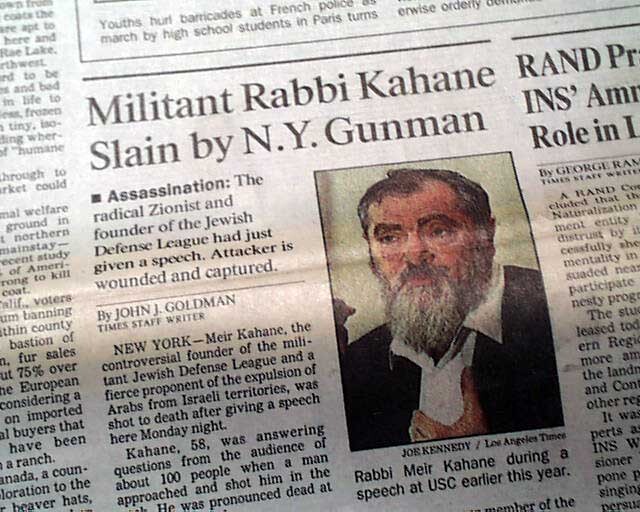
Kahane, founder of the Jewish Defense League and a former Israeli parliamentarian, was a controversial political figure whose own extremist positions had attracted considerable opposition. His assassination nevertheless marked an important chapter in the emergence of jihadist terrorism in America.
Nosair initially escaped conviction for the murder in New York state court, although he was convicted of related firearms offenses. In 1995, a federal jury convicted him of Kahane's murder as part of a broader terrorist conspiracy.

What investigators discovered after the assassination was even more consequential.
Police and FBI agents searching Nosair's residence seized Arabic-language documents, recordings and other materials containing indications of violent jihadist activity.
Among the recovered writings were references to destroying the physical symbols of Western civilization, including tall buildings and major public landmarks.
Yet much of this material was not fully translated at the time.
In a December 19, 1994, Justice Department memorandum, officials acknowledged that investigators had failed to recognize the potential significance of those references. Photographs containing the World Trade Center had also been recovered, although the FBI later stated that no specific operational plan to bomb the towers had been identified.
On February 26, 1993, terrorists detonated a massive bomb beneath the World Trade Center, killing six people and injuring more than 1,000.
The bombing's principal operational mastermind was Ramzi Yousef. Several participants, however, belonged to or were associated with the extremist network surrounding Sheikh Omar Abdel-Rahman, the Egyptian cleric known as the Blind Sheikh.
Nosair himself had connections to individuals later convicted of the bombing.
Could fuller examination of the evidence seized in 1990 have helped prevent the 1993 attack? We cannot establish that with certainty.
But the warning signs were real, and the failure to understand their significance became part of the historical record.
The Blind Sheikh's influence — and a future congressman
Omar Abdel-Rahman preached a radical interpretation of Islam that advocated violent jihad against governments and societies he considered enemies of the faith.

He was associated with Egypt's al-Gama'a al-Islamiyya, a militant Islamist movement implicated in attacks against the Egyptian state and civilians.
In 1995, Abdel-Rahman was convicted in federal court for his role in a conspiracy involving planned attacks against prominent New York targets, including tunnels and the United Nations. He was sentenced to life imprisonment.
One of the witnesses called by his defense team was Adam Hamawy.
Now, three decades after that trial, Hamawy has been elected to represent New Jersey's 12th Congressional District.

Michael Powell's November 1 investigation in The Atlantic, “The Questions Adam Hamawy Won't Answer,” revisits the relationship between Hamawy and Abdel-Rahman.
According to Powell's reporting and the trial record, Hamawy attended the sheikh's lectures, visited his home, traveled with him to a 1991 Islamist conference in Detroit, and testified on his behalf at the 1995 terrorism trial.
Under cross-examination, Hamawy acknowledged having heard Abdel-Rahman discuss jihad and identify America and Israel as enemies of Islam.
Powell characterized Hamawy as having become something of an acolyte of the sheikh. Hamawy disputes the implications of that characterization, says he condemns Abdel-Rahman's crimes, and has pointed to his later record of public service.
That record includes serving as an Army combat surgeon in Iraq, where he helped save the life of future U.S. Senator Tammy Duckworth, and providing medical assistance in war zones.
His service deserves acknowledgment. It does not eliminate legitimate questions about his earlier associations.
Nor does the trial testimony establish that Hamawy personally participated in terrorism or presently supports violent jihad.
The unresolved question is what he understood, believed, rejected or retained from his encounters with Abdel-Rahman and the broader Islamist milieu of the early 1990s.
Powell's investigation does not answer that question conclusively. It demonstrates why it deserves an answer.
Another election, another Muslim Brotherhood controversy
On November 3, 2026, Michigan voters elected Abdul El-Sayed to the United States Senate, making him the first Muslim elected to that chamber.
El-Sayed, a physician and former public-health official, campaigned on progressive domestic policies while repeatedly criticizing Israel, opposing American military assistance to the country, and describing Israel's conduct in Gaza as genocide.
During his campaign, questions also emerged about his family's reported associations with Egypt's Muslim Brotherhood.
In October, the Washington Free Beacon published social-media statements attributed to El-Sayed's maternal half-sister, University of Chicago professor Eman Abdelhadi.
In a June 24, 2012, post, Abdelhadi wrote:
“My family has long been MB.”
Other posts described relatives imprisoned for Brotherhood membership and recounted their mother Fatten Elkomy's reported activism in the organization during her college years in Egypt.
The Washington Post subsequently reported on these statements and El-Sayed's response.
El-Sayed denied personal or family ties to the Brotherhood, dismissed his half-sister's accounts as hearsay, and explained that he had been raised primarily by his father and stepmother following his parents' divorce.
The posts provide evidence of what Abdelhadi publicly claimed about her family's history. They do not independently establish El-Sayed's membership in the Muslim Brotherhood or allegiance to its ideology.
Nevertheless, they raise legitimate questions about the accuracy of his categorical public denial of family connections.
The distinction matters: family history is not personal culpability, and Muslim religious identity is not evidence of extremist belief.
But the Muslim Brotherhood is also not simply a religious identity. It is a political Islamist movement with a long and complex history. In January 2026, the U.S. Treasury Department designated its Egyptian and Jordanian branches as Specially Designated Global Terrorists, citing material support for Hamas.
Against that background, questions about the new senator's understanding of and views toward the organization are matters of legitimate public interest.
There is another relevant connection between these two elections.
On July 16, Hamawy publicly endorsed El-Sayed's Senate campaign, praising his political platform and expressing enthusiasm about working together in Congress.
Both will now have opportunities to influence American policy, including policy toward Israel and the Middle East.
That makes careful examination of their records more consequential than the controversy surrounding either campaign alone.
Kristallnacht: the warning history already delivered
Eighty-eight years ago, Nazi Germany orchestrated Kristallnacht, the nationwide pogrom remembered as the Night of Broken Glass.

On November 9–10, 1938, Nazi organizations and civilian participants vandalized thousands of Jewish businesses, burned more than 1,400 synagogues, attacked Jewish families and imprisoned approximately 26,000 Jewish men in concentration camps.
The violence was not spontaneous. It was coordinated by the Nazi regime and presented to the public as a popular response to an alleged Jewish provocation.
As the United States Holocaust Memorial Museum documents, Kristallnacht marked a devastating escalation in the persecution of Germany's Jews.
The Nazi movement had spent years preparing the ideological ground.
Jews were portrayed as enemies, blamed for national misfortunes, excluded from public life and increasingly treated as people whose businesses, institutions and rights could be attacked with impunity.
The history of Nazi collaboration with antisemitic movements also extended beyond Europe.
The former Grand Mufti of Jerusalem, Hajj Amin al-Husayni, collaborated with Nazi Germany during World War II, disseminating antisemitic propaganda to audiences in the Middle East and helping recruit Muslim volunteers into German military formations in the Balkans.
That documented collaboration does not implicate Muslims collectively. It illustrates how political antisemitism can unite otherwise distinct authoritarian and supremacist movements.
The lesson is not that every anti-Israel protest is Nazi-inspired, nor that every Muslim political figure shares the beliefs of the Blind Sheikh.
It is that antisemitic exclusion can be rationalized through different ideologies, political grievances and historical circumstances, often long before the broader public appreciates the danger.
Philadelphia, November 8: Jewish businesses targeted again
Against this historical backdrop came the events in Philadelphia on Sunday, November 8, 2026.
A group calling itself Philly Bike On Your Left, which describes itself as anti-Zionist and anti-fascist, organized a bicycle protest and boycott targeting six Jewish-owned restaurants in the city's Rittenhouse Square neighborhood.
Its publicity declared:
“No business for Zionists!”
And:
“These Zionist establishments must go!”
The targeted businesses included Goldie, Dizengoff, K'Far Cafe, Huda, Mac Mart and Schlesinger's Deli.
Several owners had supported Israeli charitable or humanitarian causes, which organizers cited among their reasons for the boycott.
One may protest Israeli government policies or call for boycotts over particular political conduct. But openly identifying Jewish-owned establishments as businesses that must disappear from a city's commercial life raises a very different concern.
The protest was also defended by Philadelphia's Democratic Socialists of America, illustrating the involvement of organized elements of the socialist left in the controversy, although that does not establish the ideology of every participant.
The event occurred on the eve of Kristallnacht's 88th anniversary.
The organizers denied choosing the date because of the anniversary.
Whether the scheduling was intentional is not established. But the resemblance between the public targeting of Jewish businesses in 1938 and the campaign to exclude Jewish-owned establishments from Philadelphia commerce in 2026 remains deeply disturbing.
The two events were not equivalent. Kristallnacht was a state-directed campaign of organized violence, murder, arson and mass imprisonment. The Philadelphia event was a protest and commercial boycott.
Yet the practice of publicly identifying Jewish businesses as unwelcome deserves serious historical scrutiny, irrespective of differences in scale or violence.
Pennsylvania's Human Relations Commission condemned the targeting, warning that publicly singling out Jewish-owned businesses conveyed a message of exclusion from civic and economic life.
The demonstration also met substantial local resistance.
Hundreds of Philadelphia residents patronized the targeted restaurants, often standing in long lines. Counterprotesters confronted the cyclists, and elected officials, including Mayor Cherelle Parker and Governor Josh Shapiro, condemned the boycott.
That solidarity matters.
But local resistance does not settle the larger question of America's national response.
Where is the sustained outrage?
National outlets, including CNN and The Washington Post, did report the Philadelphia boycott and the objections to its timing. International and Jewish news organizations also covered it.
It would therefore be inaccurate to say the event received no condemnation or national attention.
What remains open to question is whether the incident will generate the sustained public examination warranted by its significance.
Activists openly identified Jewish-owned establishments for exclusion, and their demonstration took place at one of the most historically charged moments on the Jewish calendar.
Why should such an episode be treated merely as another dispute over Middle East politics?
Why is the public targeting of Jewish-owned businesses not more consistently examined in the context of the economic exclusion that preceded the Holocaust?
And how do groups presenting themselves as opponents of fascism reconcile that identity with tactics that Jewish communities recognize from the history of antisemitic persecution?
These are questions not only for the protesters, but for the news media, universities, political leaders and organizations that claim to have absorbed the lessons of the Holocaust.
Thirty-six years of warnings
The relationship between 1990 and 2026 is not that all the people and organizations discussed here belong to one conspiracy. The evidence does not establish that.
The connection is a recurring problem of recognition and accountability.
In 1990, investigators failed to appreciate the full significance of evidence recovered after Kahane's assassination.
In 1993, terrorists connected to the same extremist environment bombed the World Trade Center.
In the years that followed, the United States learned through painful experience that militant Islamist ideology could motivate devastating violence against civilians.
Now, in 2026, two newly elected federal lawmakers face different, documented questions about their histories or associations with Islamist movements. Those questions should be examined through evidence and answered publicly, not settled by either guilt by association or accusations that every inquiry is inherently prejudiced.
At the same time, activists in Philadelphia have demonstrated how readily opposition to Israel can become a campaign against specific Jewish-owned businesses.
These developments are not identical. But together they invite examination of the ideological boundaries American society is prepared to enforce and the distinctions it is willing to defend.
There is nothing inherently objectionable about a Muslim holding public office, any more than there is about a Christian, Jew or atheist doing so. Religious freedom and equal citizenship are fundamental American principles.
What deserves scrutiny is political or religious supremacism, the justification of violence, and the willingness to marginalize Jews or anyone else because of their identity.
Those principles must be applied consistently, regardless of which political movement advances the offending ideas.
The anniversary of Kristallnacht should remind us that societies rarely recognize their gravest failures while those failures are still unfolding.
Hindsight makes historical warnings appear obvious. At the time, they are often obscured by political loyalty, ideological sympathy, indifference or the reassuring belief that matters cannot deteriorate much further.
Thirty-six years after Kahane's assassination, and 88 years after Kristallnacht, the questions remain:
What warnings are we ignoring today?
How long will we allow antisemitic exclusion and extremist ideology to become normalized before confronting them?
And what will future generations say we should have recognized while there was still time to act?
